Sight :

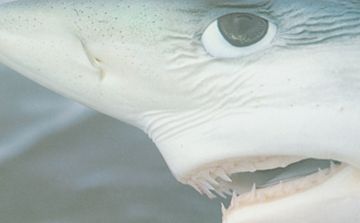
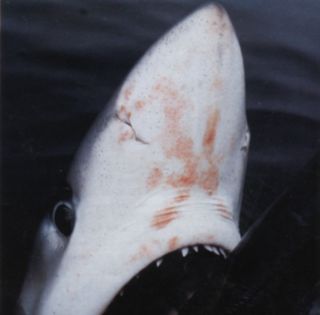
Most sharks attack from below and behind. One such example is the Great White. To do this, it has to come up fast and keep its quarry in sight. Its eyes must react rapidly to the change in light if its hunt is to be successful. All sharks rely on its array of senses to locate its prey. But its sight is crucial to pinpointing a victim at the surface, silhouetted against the light. Just as a human, entering a brightly lit room from the darkness outside, can be briefly dazzled and take a few seconds to adjust to the change, so a shark, rising to the surface from the murky depths, must cope with a rapid increase in light. It cannot afford to wait for its eyes to adjust - a lost second and the prey could be gone.
 
The secret of this ability lies in the tapetum, a layer of mirror-like plates at the back of the eyeball. By reflecting light back through the retina, it effectively doubles the amount of light for the eyes to use. The sharks' tapetum greatly enhances its vision in the murky depths but it has no iris to protect its eyes when it surfaces rapidly. In order to compensate, it has developed a 'curtain' of cells  

containing pigment. As the shark moves into bright light, these automatically expand over each tapetal plate, and then contract as it returns to the depths.

While it is swimming in shallow water, a shark needs to be able to see into the light above it and into the dark below. In this case, the tapetal curtain reacts differently in each half of the eye. The lower half of the tapetum, which reflects light from above, is covered to protect the retina. The upper half of the tapetum, which reflects light from below, is exposed to make the most of the light hitting the retina and so give a picture possible of the murky depths below.


Hearing :

Sharks do not produce any sounds themselves, but they do use sounds to locate potential prey. Certain sounds, such as the low-frequency vibrations produced as an animal struggles in the water, seemed to be of great interest to some of the larger predatory sharks. Sounds that are near the lower limit of human hearing are the most likely to attract sharks. Experiments in which sounds in the range of 25Hz to 50Hz were produced in shark infested water showed that they were easily attracted. It has also been suggested that the dull, thudding sounds made by helicopter rotor blades attract sharks; this could be very dangerous if a helicopter is rescuing a swimmer in distress in shark-infested waters. The sounds made by a single person swimming in the open water often attract sharks from a great distance.


Distant Touch :

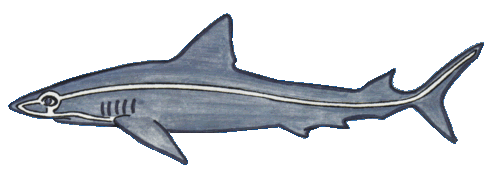
Sharks have a special sense known as distant touch. A sensing line of nerves, called the lateral line, runs along each side of the shark's body and onto its head. This important sense organ runs along either side of the body and is visible as a line of tiny pits.
 
The sensory cells that detect these sounds, which travel through the water in the form of pressure waves, are located in the fluid filled canals of the lateral line. If vibrations hit one side of the body only, as they will do if the prey is off to one side, the shark knows to turn in the direction of the strongest stimulus and swim toward it. As it gets nearer, other stimuli, such as sight or electrical activity, may take over and guide it in for the  
kill. Small pores on the shark's nose, known as Ampullae of Lorenzini, are also able to detect weak electric signals produced by its prey.


Smell :

Almost two-thirds of shark's brain is devoted to the sense of smell. As it swims through the water, a shark draws a small current of seawater through the nostrils on either side of the snout. The side-to-side movement of the head makes it easier to pick up tiny traces of chemicals scattered in the water.
Water forced into the nostrils passes over some sensory cells, which are able to detect chemicals in the water. Nerves to the olfactory lobes in the brain, which interpret the messages received, link these olfactory cells. This part of the brain, which deals with the sense of smell, is far larger in sharks than other fish and far better developed than in most other vertebrates.

A shark can detect minute amounts of a chemical and finds blood and body fluids of greatest interest. The ability to detect scents from a great distance becomes more acute in sharks which have not found food for some time - and makes them far more dangerous if they are a large and aggressive species.


Skin :

The shark's skin feels rough to the touch. In some of the larger species, it has the texture of coarse sandpaper and has even been used as sandpaper when dried. Indeed, a large shark thrashing about on the deck of a boat can inflict painful grazes on unprotected human skin if the tail rubs across it.
This roughness is due to the covering of thousands of tiny tooth-like structures that project from the skin. These are the dermal denticles, which are quite different from the smooth, flattened scales found in the bony fish. They are all directed backward,to cut down on resistance to the flow of water and help in streamlining.  
The skin secretes a slimy mucus and this is trapped by the denticles, producing a sleek body covering which does not impede the flow of water.